By
 Copy URL to Clipboard
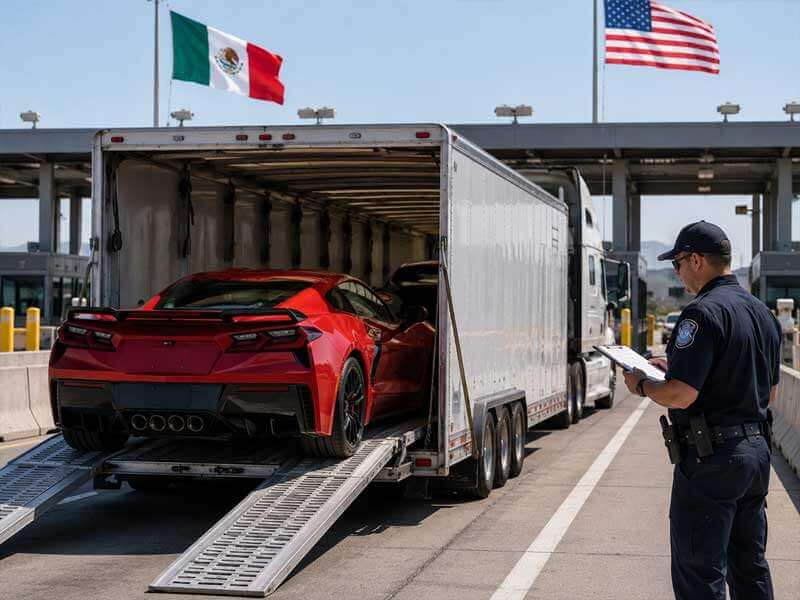
Importing a vehicle from Mexico to the United States is legal if the vehicle meets CBP, EPA, and DOT requirements and you submit the correct customs and compliance forms. The specific requirements you’ll have to meet will change based on the specifics of your shipment.
CBP accepts personal or commercial automobile imports from Mexico with the required documentation, registration, Harmonized Tariff Classification (HTS) code, customs bond, and duty payment. However, regulatory restrictions apply based on the vehicle type, carbon dioxide emissions, and manufacturing date.
Importers shipping new or used cars from Mexico follow the same CBP regulations, but with a few caveats. We’ll review these differences in the next sections.
CBP car import guidance states that motor vehicles under 25 years old from the manufacturing date must comply with Federal Motor Vehicle Safety Standards (FMVSS) to be permanently imported into the United States.
The National Highway Traffic Safety Administration (NHTSA) is an agency of the Department of Transportation (DOT) and regulates FMVSS to ensure vehicle and equipment safety is in accordance with 49 CFR § 571. A FMVSS certification label must be affixed to the driver’s side door by the original manufacturer, as well as the date of manufacture to verify the age of the car.
According to the 49 U.S. Code § 30112, importers shipping cars older than 25 years from the manufacturing date are generally exempt from FMVSS, but CBP customs clearance regulations still apply.
Imported vehicles from Mexico must comply with CBP requirements or be modified to meet U.S. import standards, which can be costly. Non-compliance for vehicles that do not meet U.S. safety requirements and CBP regulations can result in vehicles being exported or destroyed under federal supervision.
The landed cost of importing a vehicle from Mexico includes the shipment’s declared value, customs bond amount, freight transportation, and applicable customs fees, taxes, and duties.
Importers can reduce the cost of shipping by applying the correct HTS code and duty and tariff rate to the car, as well as taking advantage of Free Trade Agreements (FTA) for preferential tariff treatment if the shipment is eligible.
Tariff and duty rates are the customs fees importers pay CBP to import goods into the United States. These rates fluctuate depending on the car’s country of origin and HTS code assigned to your car, with automobiles generally classified under HTS code heading 8703.
According to CBP, imported foreign-made passenger cars are generally subject to a 2.5% duty rate based on the car’s price paid or payable.
Importers utilizing foreign trade zones (FTZ) to import or store Mexican car imports do not pay duties and taxes until the car exits the FTZ and enters CBP territory for U.S. commerce. A FTZ is a secure area in the U.S. under CBP supervision for specialized customs procedures, like manufacturing and testing products.
While car imports can remain in a FTZ indefinitely, importers must pay duties, tariffs, and other fees upon exit, like foreign-vehicle registration with the Department of Motor Vehicles (DMV).
The United States-Mexico-Canada Agreement (USMCA) is an FTA that gives importers access to preferential duty treatment on goods from each nation.
According to CBP USMCA tariff duties guidance, cars imported from Mexico generally receive duty-free treatment when they comply with USMCA’s Rules of Origin (ROO).
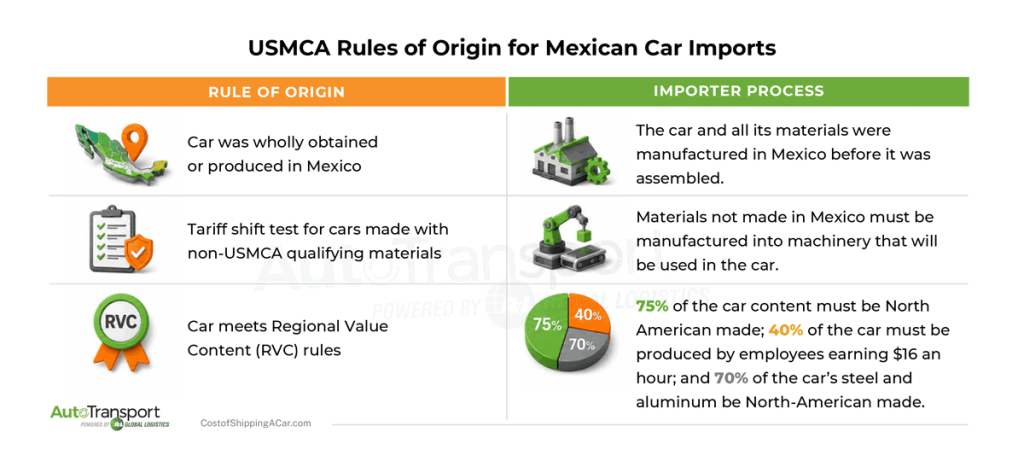
Cars that do not meet these rules must be brought into compliance with modifications to meet EPA carbon dioxide emissions requirements for vehicles and engines. Keep in mind these emission requirements vary per state, like the California Air Resources Board (CARB), so make sure your car meets your state’s rules.
EPA requires importers to use Independent Commercial Importers (ICIs) if their vehicle doesn’t conform to U.S. emission standards, lacks an EPA emission label, and doesn't qualify for any EPA exemptions. The ICA can test and modify a vehicle to ensure it meets EPA requirements.
Importers must claim preferential treatment under USMCA and the shipment must be ROO-compliant to pay zero duties.
Importers who do not claim preferential treatment or the car shipment is not USMCA eligible must pay the 2.5% Most-Favored Nation (MFN) tariff on passenger vehicles.
A customs bond is a legal contract between the Importer of Record (IOR), surety provider, and CBP that guarantees importers will pay duties, fees, and taxes on high-value or Partner Government Agency (PGA)-regulated goods.
CBP requires customs bonds for imports with a declared value of $2,500 or more. The premium importers pay to obtain a bond depends on the importer’s shipment volume, tariff and duty obligations, bond type, and bond amount.
The primary customs bond amount types are:
If you are importing a vehicle from Mexico once or less than three times a year, and its declared value is over $2,500, choose a single transaction bond.
If you are routinely importing cars from Mexico more than three times a year and the shipment total value is over $2,500, choose a continuous bond.
CBP requires CBP Form 7501, commercial invoice, Bill of Lading, EPA Form 3520-1, and DOT Form HS-7 to import cars from Mexico and all countries.
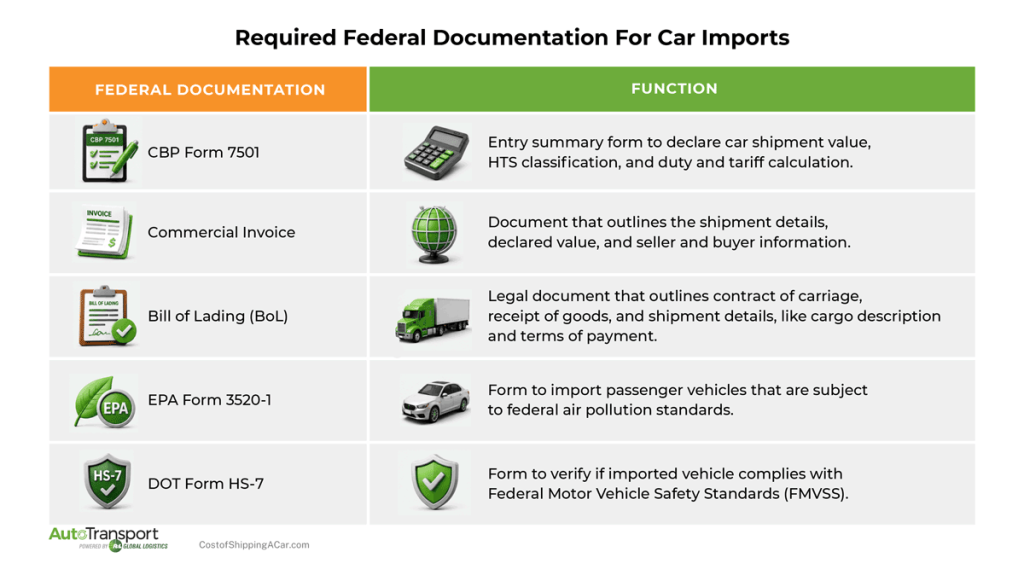
Importers claiming preferential tariff benefits should also obtain a USMCA certificate of origin to verify the claim and secure a duty-free rate. CBP doesn’t require a copy of your customs bond number and surety information, but we recommend keeping a copy for your recordkeeping.
Common mistakes when importing vehicles from Mexico are leaving personal items inside of the car, calculating duties incorrectly, and inaccurately classifying the Rules of Origin.
Importers can avoid these mistakes by working with a licensed customs broker to verify duty rate, USMCA ROO guidance, and preferential tariff eligibility.
Importing a vehicle from Mexico can involve CBP entry, EPA compliance, DOT documentation, bond selection, and duty classification. If you want help validating your documents before shipment, speak with our customs team or request a free quote. Speak with our team, risk-free, at (866) 322-1381 or share your shipment details to get a free quote today.
Sources:
Importing a Motor Vehicle, Customs and Border Protection, 2026
Laws and Regulations, National Highway Traffic Safety Administration
49 CFR § 571 - Federal Motor Vehicle Safety Standards (FMVSS)
49 U.S. Code 30112 - Prohibitions On Manufacturing, Selling, and Importing Noncomplying Motor Vehicles and Equipment
About Foreign - Trade Zones and Contact Info, Customs and Border Protection, 2024
Registering a Foreign Vehicle or Motorcycle with the Department of Motor Vehicles, Customs and Border Protection, 2026
USMCA Overview, International Trade Administration
USMCA - Are There Tariff Duties On Goods Imported from Canada and Mexico?, Customs and Border Protection, 2026
Learn About Importing Vehicles and Engines, United States Environmental Protection Agency, 2025
Frequently Asked Questions, California Air Resources Board
When is a Customs Bond Required, Customs and Border Protection, 2026
Copy URL to Clipboard


I need to ship a car from Mexico to the US and would like to speak with an agent about my personal needs.
Please respond to this message via email, below.
Thank you